
Universal Dreams: The 12 Dream Themes Every Human Shares
Across cultures, languages and centuries, humans dream the same dreams. Research reveals what these universal themes are telling us.
Quick Answer
Research by Dr. Patricia Garfield, drawing on dream reports from 36 countries, identified 12 universal dreams that appear consistently across cultures worldwide. Being chased, falling, being lost or trapped, and appearing naked are the four most universally reported negative themes. Flying is the most common positive dream. These universal dreams arise from our shared human biology, evolutionary history and common emotional experience, though the personal meaning of each dream is always unique to the individual dreamer.
Table of Contents
- Quick Answer
- The Discovery of Universal Dreams
- The Four Most Common Negative Universal Dreams
- The Most Common Positive Universal Dreams
- Why Do We All Have the Same Dreams?
- Personal Meaning Within Universal Dreams
- Color Across Cultures
- Dreams of the Body
- Visitation Dreams and Grief
- What This Means for Dream Interpretation
- Frequently Asked Questions
Garfield, who holds a doctorate in clinical psychology and has studied universal dreams across cultures for decades, co-founded the International Association for the Study of Dreams and has maintained her own personal dream journal since the age of 14. To research the book she drew on that journal, on dreams collected from individuals over many years, and on the first 500 dreams submitted through her website by dreamers in 36 countries. What emerged was a map of the human dreaming mind that transcends geography, language and culture.
The Discovery of Universal Dreams
The research identified 12 universal dreams that appear consistently across the full range of human cultures studied. These are not vague categories but specific, recognisable experiences: being chased, falling, being lost, appearing naked, flying, and others that virtually every adult on earth will recognise from their own dream life.
The existence of these universal dreams raises an immediate question. Why should a person in Lithuania, a farmer in rural China, a student in Brazil and a professional in Sydney all dream of standing naked in a public place, or of being chased by a threatening figure they cannot quite identify? The answer lies partly in our shared biology, partly in our evolutionary history, and partly in the common emotional experiences that define human life regardless of where it is lived.
What is equally important, however, is what these universal dreams do not tell us. They do not tell us what the dream means for the individual dreamer. The theme is the starting point. The personal meaning lives in the details, the feelings, the specific imagery, and the waking life context that only the dreamer can supply.
The Four Most Common Negative Universal Dreams
Across all cultures studied, the single most commonly reported universal dream was being chased or attacked. The pursuer varies: adults are more likely to be followed by threatening human figures, dangerous strangers or enemies. Children more commonly dream of wild animals. But the fundamental experience, of being pursued by something threatening and trying to escape, is universal at every age.
These dreams tend to arise when we feel threatened by some person or situation in waking life. The threat can be external, a difficult relationship, a workplace conflict, a perceived danger. It can also be internal, such as a fear of losing control or of some aspect of oneself that feels dangerous or unacceptable. Garfield notes that these dreams may also carry an evolutionary echo. For most of human history, being chased by predators or members of rival groups was a genuine survival threat. The emotional circuitry that produced those ancient chase dreams remains active in the modern dreaming brain, now recruited to process contemporary fears.
The second most common universal dream is falling, sometimes ending in drowning. The third is being lost or trapped, absolutely caught in a situation with no way out. The fourth is being naked or inappropriately dressed in a public or important setting, with the occasional variation of being the only person with clothes on while everyone else is undressed.
Each of these universal dreams has a recognisable emotional signature. Falling tends to relate to a loss of support, control or confidence in waking life. Being lost or trapped mirrors feelings of being stuck, overwhelmed or unable to find a way forward. Being naked in public is one of the most universally understood metaphors in human experience: the feeling of exposure, vulnerability and the fear of being seen as inadequate or unprepared.
These universal dreams share something important. They are all, at their core, about threat. Threat to physical safety, threat to status, threat to self-image, threat to the sense of being in control of one’s own life. The dreaming brain returns to these themes again and again because the emotional processing they represent is fundamental to psychological survival.
The Most Common Positive Universal Dreams
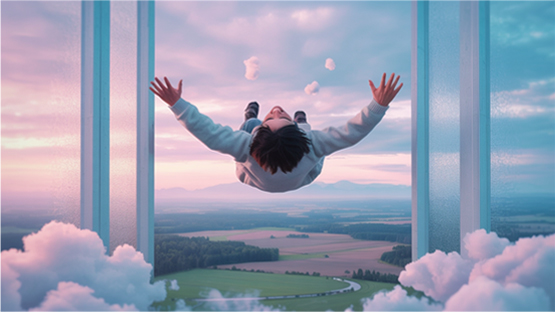
Flying is almost universally the most loved of all universal dreams. People rarely want to wake from flying dreams. They produce a sense of uplift, freedom and confidence that feels unlike ordinary waking experience. Even flying dreams that contain some element of threat, such as low-hanging wires or uncertainty about altitude, tend to be experienced as encouraging and expansive. Many dreamers describe a spiritual quality to flying dreams, a sense of connection to something larger than ordinary life.
Related to flying are dreams of swimming underwater joyfully, moving through a different medium with ease, and dreams of dancing with complete freedom and exhilaration. These share the essential quality of the flying dream: the liberation from ordinary constraint, the body moving through the world in ways waking life does not permit.
Dreams with romantic and sexual content are also among the most universally positive. Women’s versions tend toward the romantic, beautiful settings and deeply desirable partners. Men’s versions can be equally romantic, though they may also be more direct. In both cases the dreamer wakes reluctantly, the body having experienced something that felt completely real and entirely satisfying.
Less common but extraordinarily powerful when it occurs is the dream of a meaningful connection with someone who has died. These visitation dreams carry a distinctive quality that dreamers consistently describe as different from ordinary dreaming. The deceased person appears alive and present, often with a message of continuing love, reassurance or guidance. Many people report that such a dream changed their relationship to grief and to their understanding of what lies beyond death, though whether these experiences represent genuine contact or a profound form of psychological healing remains, as Garfield notes, beyond the reach of scientific proof.
Why Do We All Have the Same Dreams?
The universality of these dreams is not coincidental. It reflects something deep in the architecture of the human brain and the shared emotional landscape of human experience.
Part of the explanation is evolutionary. Certain threats, certain dangers, certain fundamental desires and fears, have been constant features of human life across all cultures and throughout our entire history as a species. The brain regions most active during dreaming, particularly the limbic system and its emotional processing centers, are among the oldest and most conserved structures in the human brain. They generate dream content from emotional material that is, in its deepest roots, shared by all humans.
Part of the explanation lies in the metaphor-making systems of the brain. Research on the areas of the brain responsible for creating metaphors has found that certain metaphors appear across cultures because they emerge from the same neural architecture. The inferior right parietal cortex, which is highly active during dreaming and responsible for forming visual associations and processing metaphors, appears to generate common figurative patterns across different cultural and linguistic backgrounds. The naked dream is a direct translation of the universal human feeling of being exposed and vulnerable. The falling dream maps directly onto the universal experience of losing support. These are not culturally learned symbols. They are the brain’s native language for describing emotional experience, and it is the same language everywhere.
Part of the explanation is also cultural. Certain metaphors are shared within cultures and across cultures with historical connections, appearing in dreams because they have become part of the shared emotional vocabulary of a people. The dreaming brain borrows freely from cultural imagery, personal memory and collective metaphor, weaving them together into the narrative of the dream.
Personal Meaning Within Universal Dreams
The existence of universal dreams does not mean that dream dictionaries work. It means the opposite.
A universal dream tells you the category of emotional experience the dream is processing. It does not tell you what that experience is for you. Two people can dream of being chased and be processing entirely different waking life situations. Two people can dream of flying and feel completely different things. The emotional quality of the dream, and its connection to the dreamer’s specific waking life, is always personal.
Garfield is direct about this. When working with a chase dream, she recommends asking not just what is chasing you but how you would describe it in detail. What shape is it? What size? What is its outstanding characteristic? The words that come out of that description tend to be metaphors that point directly to something in waking life. A chaser described as having wild, crazy hair pointed one dreamer toward someone in her life whose thinking she experienced as wild and unpredictable. The dream had borrowed that physical detail as its way of naming something the rational waking mind had perhaps not clearly articulated.
Similarly, asking how the dream ended, whether the dreamer escaped, faced the threat, received help or was overwhelmed, reveals important information about the dreamer’s current relationship to whatever the chase represents. The universal dream is the frame. Everything inside it is personal.
The most direct way to access that personal meaning is to ask how you felt in the dream. Not what happened, but how it felt. A flying dream in which the dreamer felt completely free is telling one story. A flying dream in which the dreamer felt dangerously out of control is telling quite another. The emotional quality of the experience is the dream’s primary communication, and it is always specific to the individual.
Color Across Cultures
Research into cross-cultural color symbolism reveals another layer of universality in dreaming. Anthropological scholarship has identified that three colors appear as primary symbolic colors across virtually all human cultures: black, white and red. These three are thought to derive from their universal existence as the colors of the most emotionally significant human experiences. Red is the color of blood, and thus of life, danger, passion and action across cultures worldwide. White and black carry associations with light and dark, consciousness and the unknown, presence and absence, that appear in the symbolic systems of cultures with no historical connection to each other.
Within dream research, color has been found to carry emotional information that operates below the level of conscious cultural learning. As discussed in the research of Robert Hoss, the human autonomic nervous system responds to color in predictable ways, and these physiological and emotional responses appear to carry over directly into the dream state. Red excites and activates. Blue calms and soothes. These responses are not culturally taught. They are built into the human nervous system, making the emotional language of color in dreams another form of universal communication.
Dreams of the Body
One dimension of universal dream research that receives less attention than it deserves is the relationship between dreams and physical health. Garfield has researched and written extensively on what she calls body dreams, dreams that reflect physical conditions, illness or injury, often before the dreamer has become consciously aware of the problem.
Pain experienced during a dream is one of the most reliable signals. We rarely feel physical pain in dreams. Dramatic events occur, things fall and break and injure, but the dreamer typically observes without experiencing physical sensation. When pain does occur in a dream, particularly pain located in a specific area of the body, it consistently merits attention. The dreaming brain may be registering a physical disturbance that has not yet risen to conscious awareness.
The body is often represented in universal dreams through buildings, houses, vehicles and machinery. When these dream representations show damage, malfunction or breakdown, it is worth considering whether the dream may be reflecting something happening in the physical body. A car with failing brakes, a house with structural damage, machinery that will not function correctly, these images can be purely metaphorical, representing psychological or life situations. They can also be the dreaming brain’s way of communicating something physical.
Temperature in dreams also carries body information. Dreams of cold, ice and freezing can reflect actual physical coldness, such as a cold room or dropping body temperature. But they more frequently relate to emotional coldness, to feelings of being unloved or disconnected. As with all dream imagery, both levels of meaning should be considered.
Garfield is careful to note that these signals always require interpretation rather than alarm. Dream imagery always speaks in metaphor. A pain in a dream location warrants observation and perhaps a medical check. It is not a diagnosis. The personal metaphorical meaning should always be explored alongside any physical interpretation.
Visitation Dreams and Grief
Among the most powerful of all universal dreams are dreams of those who have died. These appear across all cultures and throughout all of recorded human history. They are universal not because cultures have taught people to expect them but because grief itself is universal, and the dreaming brain processes grief as it processes all emotionally significant experience, through vivid, emotionally intense narrative.
What distinguishes what Garfield calls true visitation dreams from ordinary grief dreams is a quality that dreamers consistently describe but find difficult to articulate: a sense of presence, reality and significance that feels categorically different from ordinary dreaming. The deceased appears not as a memory but as genuinely present. There is often a direct message, of continuing love, of reassurance, of guidance for the living.
Whether these experiences represent genuine contact with the deceased or a profound form of psychological healing through the dreaming brain remains, as Garfield acknowledges, beyond scientific proof. What is not in question is their effect. People who have such dreams consistently report significant shifts in their relationship to grief, to loss and to their understanding of what death means.
More commonly, universal dreams of the deceased form part of the natural process of grieving itself. These dreams can be painful, the person appearing alive, the loss not yet real, the dreamer waking to grief all over again. But even painful dreams of this kind serve a purpose. They help the dreamer move through the stages of accepting the reality of the loss, integrating it into their sense of who they are and what their life now is, and beginning to build a future that is different but still possible.
What This Means for Dream Interpretation
The research into universal dreams confirms something that the neuroscience of dreaming also tells us: that dreams operate in a language that is both universal and deeply personal at the same time.
The universal layer explains why certain dream themes recur across all cultures. They arise from shared biology, shared evolutionary history and the common emotional architecture of human experience. When you dream of falling, you are having one of the most universal dreams in human history, something people have dreamed in every culture on earth since before recorded time.
The personal layer is where interpretation lives. The universal dream tells you what kind of emotional territory the dream is working in. Your specific feelings, imagery, associations and waking life context tell you what that territory looks like for you right now.
This is why no dream dictionary can tell you what your dream means. A dictionary can tell you that falling dreams tend to relate to loss of support or control. That is the universal layer. What you are losing support around, what you feel out of control of, what specific situation in your current life carries that emotional quality, only you can know. The universal dream points to the territory. You navigate it.
This is the foundation of the D.R.E.A.M.S. Method™, which works with both the universal patterns that the research has identified and the personal associations that give those patterns their specific meaning for each individual dreamer. If you’d like to learn the complete framework, visit our D.R.E.A.M.S. Method™ tutorial.
Frequently Asked Questions
What are universal dreams?
Universal dreams are dream themes that appear consistently across all human cultures worldwide. Research by Dr. Patricia Garfield, drawing on dream reports from 36 countries, identified 12 such themes. The most common include being chased or attacked, falling, being lost or trapped, and appearing naked in public. Universal dreams arise from shared human biology and emotional experience rather than cultural learning, which is why they appear in every culture throughout recorded history.
What are the most common universal dreams?
The four most universally reported negative dream themes are being chased or attacked, falling, being lost or trapped, and appearing naked or inappropriately dressed. The most universally reported positive dream is flying, followed by romantic or sexual dreams. Dreams of meaningful connection with people who have died are also widely reported across cultures, though less common than the others.
Why do people all over the world have the same dreams?
Universal dreams arise from shared human biology, evolutionary history and common emotional experience. The brain regions most active during dreaming are among the most ancient and conserved structures in the human brain, generating dream content from emotional material that is fundamentally shared across all cultures. The metaphor-making systems of the dreaming brain also produce certain common figurative patterns across cultural and linguistic boundaries, because certain emotional experiences, such as feeling exposed or losing support, are universal to human life.
Does a universal dream mean the same thing for everyone?
No. A universal dream identifies the category of emotional experience the dream is processing, but the specific personal meaning is always unique to the individual dreamer. Two people can have the same chase dream and be processing entirely different waking life situations. The universal theme is the frame. The personal meaning lives in the details, the feelings, and the specific waking life context that only the dreamer can supply.
What is the most positive universal dream?
Flying is almost universally the most loved dream experience across cultures. Flying dreams typically produce feelings of freedom, uplift, confidence and sometimes a sense of spiritual connection. Even flying dreams that contain elements of difficulty or threat tend to be experienced as encouraging overall. The personal meaning always depends on how the dreamer felt in the dream and what that feeling connects to in waking life.
Explore the 12 Common Dream Themes
Falling Dreams
Animal Dreams

Being Lost or Trapped

Naked dreams

Flying Dreams

Romantic/Sexual Dreams

Death Dreams

Teeth Falling Out

Water Dreams

House Dreams

Vehicle Dreams

Being Chased or Attacked

Start Interpreting Your Dreams Today
Ready to decode your dreams using personal interpretation rather than generic meanings? Here is how to begin:
Explore a Specific Dream Theme
Click on any of the 12 dream themes above to get detailed interpretation guidance using the D.R.E.A.M.S. Method™. Each page provides:
- Common variations of that dream type
- Research-backed interpretation approaches
- Step-by-step analysis using the D.R.E.A.M.S. Method™
- Real examples showing personal interpretation in action
Learn the D.R.E.A.M.S.
Method™
My foundational method for analyzing any dream.
The Psychology of
Dreaming: A Beginner’s
Guide
Understand the science behind why we dream.
Why Personal Interpretation Works Better: The Research
Multiple lines of research support the personal interpretation approach over generic dream dictionaries:
Cross-Cultural Evidence: Dr. Patricia Garfield’s 36-country study shows that while themes are universal, meanings are deeply personal and cultural.
Neuroscience Validation: Dr. David Kahn’s Harvard research shows that with logical reasoning offline during dreams, your emotional and associative responses provide the most reliable interpretation pathway.
Clinical Evidence: Dr. Gayle Delaney’s 30+ years of clinical practice demonstrates that the “aha!” moment comes from personal recognition, not external interpretation.
Memory Research: Dreams are composed of your memory fragments and personal associations, making personal interpretation more accurate than generic meanings.
Your unconscious mind speaks YOUR language, not a universal one. Learning to decode that personal language is the key to understanding what your dreams are really telling you.