
The D.R.E.A.M.S. Method™
How to Interpret Your Dreams Step-by-Step
Stop guessing what your dreams mean.
Learn the proven 6-step system that unlocks your
dream’s personal message in minutes.
What is the D.R.E.A.M.S. Method™?
The D.R.E.A.M.S. Method™ is an easy to follow 6-step approach to dream interpretation that helps you discover your dream’s personal meaning. Unlike dream dictionaries that give generic interpretations, this method uses your own associations and life experiences to unlock what your specific dream means to you. Research shows that you are the expert on your own dreams – symbols mean what they mean to you personally, not what a book says they should mean.
The 6 steps are: Document, Record, Extract, Analyze, Map, and Solve—creating a complete framework for understanding any dream.
Table of Contents
- Why Dream Dictionaries Don’t Work
- The D.R.E.A.M.S. Method™ Overview
- Step : D – Document Your Dreams
- Step : R – Record Complete Details
- Step : E – Extract Dream Symbols
- Step : A – Analyze Symbol Meanings
- Step : M – Map Themes and Feelings
- Step : S – Solve Waking Life Connections
- Complete Dream Example
- Troubleshooting Common Challenges
- What the Research Says
- Getting Started Today

Considering how much time we spend dreaming, the real meaning of dreams seems to elude most of us.
We know surprisingly little about why we dream, how we create the images we see, or what purpose it serves us as a species. How many times have you dreamt about something, then googled your dream to try and figure out what it meant? I know I used to do that all the time… until I got increasingly disappointed with the one-sentence answers I found on the dream dictionary sites. And although it satisfies that instant need for an answer, you gain no better knowledge of yourself or your dreams.
Really, when you think about it, how could a random online dream dictionary give you any insight into something you – a very unique human being with your own ideas about life – created?
That’s why I created Real Meaning of Dreams and developed the D.R.E.A.M.S. Method™.
This website is the product of many months of research (and over years of studying dreams) and my desire to provide the real answers to YOUR dream questions. Not by telling you what your dreams mean, but by showing YOU how you can become your own dream expert. By teaching you how to interpret dreams yourself. And it’s not hard!
Why Dream Dictionaries Keep You Stuck
Here’s the truth: NO dream dictionary can help you understand yourself.
Think about it. You dreamed about a dog. The dream dictionary says it means “loyalty.” But what if you were bitten by a dog as a child? What if your ex-boyfriend had a dog you hated? What if you’re a mail carrier who gets chased by dogs daily? Suddenly “loyalty” makes no sense at all.
Your dreaming brain creates the images you see every night, so it makes sense that only you – the author of your dreams – can make sense of what they mean.
Dr. Gayle Delaney, one of the leading dream researchers, puts it perfectly: “The dreamer is the expert.” Your personal associations with symbols – shaped by your experiences, memories, relationships, and current life circumstances – are what give dreams their meaning. Although we do often dream about common themes, our dreams are essentially unique to each and every one of us. And this is the most important factor to understand when dealing with dreams.
Research from Dr. Alan Siegel shows that dreams consistently reflect our current life situations, transitions, and concerns. They’re not pulling from some universal symbol dictionary in the sky. They’re pulling from YOUR life, YOUR memories, YOUR worries, YOUR hopes.
What Happens When You Rely on Dream Dictionaries
Common problems with generic dream interpretation:
- Interpretations feel shallow or irrelevant to your actual situation
- You find generic meanings that don’t match your dream’s emotional tone
- You’re left more confused than when you started
- You wonder if your dreams even mean anything at all
- You miss the real message your unconscious mind is trying to send
The D.R.E.A.M.S. Method™ solves these problems by focusing on what matters most: your personal connection to the dream.
The D.R.E.A.M.S. Method™ Overview
A Systematic Approach to Personal Dream Interpretation
The D.R.E.A.M.S. Method™ is a six-step process that guides you from “I had a weird dream” to “I understand what my dream is telling me about my life.” We teach you to become your own dream expert. Here’s how it works:
| D | Document | Record dream details immediately upon waking |
| R | Record | Note your current life situation and emotions |
| E | Extract | Identify key symbols, people and actions |
| A | Analyze | Explore your personal associations with each symbol |
| M | Map | Connect dream themes and emotions to waking life |
| S | Solve | Discover how your dream relates to your current life situation |
Each step builds on the last, guiding you from the raw dream material to genuine insight. And here’s what I love about this method: it works for any dream, whether it’s a common theme like being chased or something completely bizarre that you’ve never dreamed before.
Let me walk you through each step in detail.
The Complete 6-Step D.R.E.A.M.S. Process
STEP D
 Document Your Dream
The 5 Minute Window
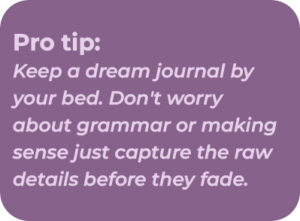
Here’s something that will change how you approach dream recall: research by Jean Campbell shows that within five minutes of waking, you’ve already forgotten 50% of your dream. Wait ten minutes, and 90% is gone.
Think about that. Your dream is literally evaporating as you lie there deciding whether to get up.
That’s why documentation is step one. Not “think about it over breakfast.” Not “I’ll write it down later.” Immediately.
How to Capture Dreams Fast
Keep your recording method within arm’s reach of your bed. This could be:
- A notebook and pen on your nightstand
- Your phone with a notes app or voice recorder
- A dedicated dream journal
The moment you wake – capture something. Even if it’s just “vampire, running, city, scared.” You can fill in details later, but you need those anchor points while they’re fresh.
The “Dreams Pay Attention” Principle
Here’s something fascinating from Jean Campbell’s research: dreams pay attention to you when you pay attention to them.
She found that people who consistently record their dreams remember more dreams, and remember them in greater detail. It’s as if your dreaming mind realizes, “Oh, she’s actually listening!” and starts communicating more clearly.
So even if you only remember fragments at first, keep documenting. Your recall will improve dramatically within a few weeks.
STEP R
 Record Your Current Life Situation
Once you’ve captured the basic dream, expand it with full details. This is where you transform “vampire, running, city, scared” into a complete narrative.
What to Record
The Dream Itself:
• What happened, in sequence
• Who was there (people, animals, creatures)
• Where it took place (settings, locations)
• What objects stood out
• How you felt throughout
• Any vivid colors or sensory details
• The atmosphere or mood
Your Waking Life Context:
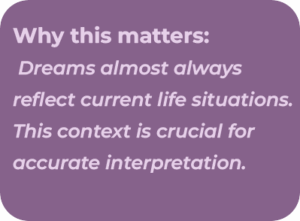
This is crucial and often overlooked. Dr. Alan Siegel’s research shows that dreams consistently reflect our current life circumstances, especially during transitions and stressful periods.
Record:
• What’s happening in your life right now
• Any major decisions you’re facing
• Relationships that are on your mind
• Work or school situations
• Recent events or conversations
• How you felt when you went to bed
A dream about being chased means something very different if you recorded it during a job search versus during a happy vacation. Context is everything.
Note Colors for Later Exploration
If certain colors stood out in your dream – vivid reds, deep blues, unusual color combinations – make a note. We’ll explore their significance in the Map step, where color psychology research by Robert J. Hoss shows that vivid colors often signal emotionally significant content.
STEP E
 Extract the Dream Symbols
Now that you have the complete dream recorded, it’s time to identify the key symbols – the elements that carry meaning.
The Five Categories of Dream Symbols
Based on years of dream analysis, I’ve found that dream symbols fall into five main categories:
Dream Stars (People & Characters)
• Who appeared in your dream?
• Real people from your life?
• Strangers, celebrities, or fictional characters?
• Animals or mythical creatures?
Actions
• What were you doing?
• What were others doing?
• Running, flying, falling, searching, fighting?
Objects
• What things stood out?
• Vehicles, weapons, tools, technology?
• Personal items, gifts, documents?
Settings
• Where did the dream take place?
• Your home, workplace, school?
• Unknown locations, fantastical places?
• Indoor or outdoor? Familiar or strange?
Feelings
• How did you feel in the dream?
• Fear, joy, confusion, anger, peace?
• Did your feelings change throughout?
Dr. Stanley Krippner’s research emphasizes that emotions are the KEY to dream meaning. The feelings in your dream often matter more than the specific symbols.
Identifying the “Stars”
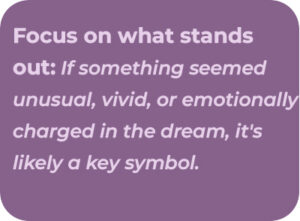
Not every element in your dream is equally important. Some are just background scenery. The “stars” are the symbols that:
• Stood out vividly
• Appeared multiple times
• Felt significant or unusual
• Triggered strong emotions
• Were central to the dream action
Circle or highlight these in your dream record. These are what you’ll analyze in the next step.
STEP A
 Analyze Your Personal Associations
This is where the real interpretation work happens. For each key symbol you’ve identified, you’ll explore what it means to YOU personally.
The Magic Questions (Robert J. Hoss)
Dream researcher Robert J. Hoss developed a powerful technique called the ” Magic Questions.” These questions help you uncover your personal associations with dream symbols. For each important symbol, ask yourself: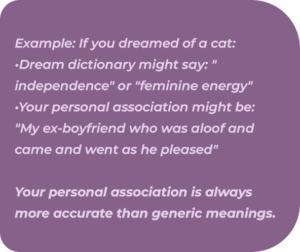
What is it?
Describe the symbol as if explaining it to someone who’s never seen it before. This often reveals unexpected associations.
Example: “A vampire is a creature that drains life force from others, operates in darkness, can’t be seen in mirrors…”
What does it do? What is its function or purpose?
Focus on the action or role of the symbol.
Example: “It pursues, it hunts, it takes what it needs without permission…”
What is its most striking characteristic or quality?
What stands out most about this symbol?
Example: “It’s relentless. It doesn’t stop. It’s powerful and I’m powerless against it.”
What does it remind you of in your waking life?
This is where personal associations emerge. Be honest, even if the connection seems strange.
Example: “It reminds me of my ex-boyfriend – the way he would drain my energy, how I felt powerless in that relationship…”
How do you feel about it?
Your emotional response to the symbol is crucial.
Example: “Terrified. Hunted. Like I can’t escape.”
What aspect of yourself might this represent?
Sometimes dream symbols represent parts of ourselves we’re not acknowledging.
Example: “Maybe it’s the part of me that feels drained by that relationship, or my fear that I’ll never be free of its influence…”
Working Through Your Symbols
Go through each key symbol using these questions. Write down whatever comes to mind, even if it seems silly or unrelated. Often the “silly” associations are the most revealing.
Pay special attention to metaphors and word-play. Dream researcher Jeremy Taylor found that dreams love puns and double meanings. A “board meeting” might literally involve boards of wood. Being “tied up” at work might appear as being literally tied with ropes. One interesting dream I had along these lines involved bees flying out of my knee ( The bee’s knee literally!)
STEP M
 Map the Themes and Feelings
Now you’ll connect the individual symbols to see the bigger picture – the emotional message your dream is conveying.
Identifying the Central Theme
Look at all your symbol analyses together. What patterns emerge? What’s the common thread?
Common dream themes include:
• Feeling powerless or out of control
• Avoiding confrontation or difficult situations
• Anxiety about performance or appearance • Processing loss or change
• Exploring desires or possibilities
• Working through relationship dynamics
Dr. Stanley Krippner’s research shows that emotions are the KEY to understanding dreams. The feeling tone of your dream – the emotional atmosphere – often matters more than the specific symbols.
Ask yourself:
• What was the dominant emotion in this dream?
• Did it remind me of how I feel in any waking life situation?
• What is my dreaming mind trying to process?
Color Psychology in Dreams
If vivid colors appeared in your dream, this is where we explore their significance. Robert J. Hoss’s pioneering research on color in dreams shows that vivid, unusual, or striking colors often signal emotionally significant content.
How to Work with Dream Colors:
- Note which colors stood out – Were they unusually vivid? Did they seem out of place?
- Explore your personal associations – What does this color mean to YOU?
- Red might mean danger, passion, anger, or your favorite color
- Blue might mean calm, sadness, cold, or the ocean you love
- Dark colors might mean fear, mystery, or simply nighttime . Consider universal associations – While personal meaning comes first, some color associations are widely shared:
- Red: danger, passion, energy, warning
- Blue: calm, sadness, water, sky • Green: growth, nature, envy, freshness
- Yellow: happiness, caution, sunlight
- Black/Dark: fear, unknown, night, mystery
- White/Bright: clarity, purity, emptiness, new beginnings
Connect to emotions – Hoss found that vivid colors often accompany strong emotions. The color and the feeling work together to create meaning.
Remember: your personal associations always trump generic meanings. If yellow reminds you of your grandmother’s kitchen, that’s more significant than any “universal” meaning.
Connecting Emotions and Symbols Dr. David Kahn’s neuroscience research helps explain why dreams feel so emotionally intense: during REM sleep, the emotional centers of your brain (particularly the amygdala) are highly active, while the logical, rational prefrontal cortex is less active.
This means your dreams are processing emotions in a raw, unfiltered way. The bizarre symbols and impossible scenarios are your brain’s way of working through feelings that are hard to express logically.
So when you map your dream, focus on the emotional truth, not the literal events. A dream about your teeth falling out isn’t predicting dental problems – it’s expressing feelings of powerlessness or loss of control in some area of your life.
STEP S
 Solve the waking Life Connection
This final step is where everything comes together. You’ve documented the dream, extracted the symbols, analyzed their personal meanings, and mapped the emotional themes. Now: what is this dream telling you about your waking life?
Making the Connection
Ask yourself:
• Where in my current life do I feel the way I felt in this dream?
What situation does this dream’s theme reflect?
• What is my dreaming mind trying to help me understand or process?
• Is there a decision I’m avoiding? A feeling I’m not acknowledging?
Dr. Deirdre Barrett’s research at Harvard shows that dreams often work on problems we’re facing. In one study, she found that when people “incubated” dreams about specific problems (by thinking about the problem before sleep), about 60% had dreams that offered solutions or new perspectives. Your dreams aren’t random. They’re your mind’s way of processing experiences, working through emotions, and sometimes offering insights you haven’t consciously recognized.
The “Aha!” Moment
When you’ve found the right connection, you’ll know it. There’s usually an “aha!” moment – a sense of recognition, of pieces clicking into place. The dream suddenly makes sense in the context of your life.
That vampire chase dream? When the dreamer realized it represented her ex-boyfriend who had emotionally drained her, and her fear that she’d never escape his influence – everything clicked. The unknown city was her new life after the breakup. The relentless pursuit was her anxiety that the past would follow her. The powerlessness was exactly how she’d felt in that relationship.
What If Nothing Clicks?
Sometimes the connection isn’t immediately obvious. That’s okay. Keep the dream in mind as you go through your day. Often the meaning will reveal itself when you encounter the relevant situation.
Or the dream might be processing something from your past, or exploring a possibility for your future. Not every dream is about your current circumstances.
And some dreams are just your brain doing maintenance – sorting memories, processing random thoughts. Not every dream has deep meaning, and that’s fine too.
Real Example: Chase Dream Analysis
Complete D.R.E.A.M.S. Method™ Walkthrough
Let’s see how the method works with a real dream analysis:
Real Example: Chase Dream Analysis
Complete D.R.E.A.M.S. Method™ Walkthrough
Document Your Dream
Record the complete dream with all details, emotions, and impressions
Raw Dream Record:
I was in some unknown city from the past, and a vampire was stalking me. I knew I was the next victim. The vampire was sending me letters, counting down the time until he would kill me. One package contained blood. I was walking through the city and felt the vampire following me. I ran through a dirty, deserted alleyway, and I managed to escape, but it felt like the vampire was playing a game he was playing.
Record Complete Context
Note what was happening in your life when you had this dream
Life Context:
Recently broke up with a non-committal boyfriend. He is still calling and harassing me, giving me hope and then taking it away.
Extract Key Symbols
Identify the most significant elements that stood out in the dream
Vampire (main character)
The primary threatening figure in the dream
Letters/packages
Communication method from vampire
Blood (life force/energy)
Contents of one package
Old city (unfamiliar territory)
The setting of the chase
Dirty alleyway
Dangerous place of escape
Chase/stalking
Pursuit dynamic throughout dream
Analyze Personal Associations
What each symbol means to YOU specifically, based on your experiences
- Vampire: A creature that preys on victims, taking their life force to survive. Charming, manipulative, and powerful.
- Letters: Impersonal way to communicate, often used to toy with someone.
- Blood: Life force being drained or threatened.
- Alleyway: A scary place where harm could happen.
- Being chased: Feeling hunted, unable to escape someone's influence.
Map Themes and Feelings
Identify the emotional patterns and dominant themes
Dominant Themes:
Feeling powerless and helpless
Energy being drained by someone else
Core emotion: Intense fear and helplessness in the face of someone else's power
Solve the Connection
Connect the dream insights to your current waking life situation
The Breakthrough Question:
"Who in my life makes me feel powerless, helpless, and scared? Who is 'toying' with me emotionally?"
The Connection: The dream perfectly captured my relationship with my ex-boyfriend. Like the vampire, he was "draining my life force" through his manipulative behavior—calling to give me hope, then pulling away. The "letters" represented his intermittent contact that kept me emotionally hooked but fearful. I felt hunted and powerless, just like in the dream.
The Insight: This dream helped me recognize that I was allowing someone to have vampire-like power over my emotional well-being. It was time to stop running and take back my power.
Troubleshooting Common Challenges
"I Can't Remember My Dreams"
This is the most common challenge, and the good news is that dream recall is a skill you can develop.
Solutions:
• Keep your recording method within arm’s reach
• Set an intention before sleep: “I will remember my dreams”
• Don’t move when you first wake up – lie still and let the dream come back
• Start with fragments – even remembering “something about water” is progress
• Be consistent – Jean Campbell’s research shows recall improves dramatically with practice Remember: dreams pay attention when you pay attention to them.
"My Symbols Don't Make Sense"
Sometimes you’ll analyze a symbol and draw a complete blank. That’s okay.
Solutions:
• Try free association – say the first thing that pops into your head
• Ask “What does this remind me of?” instead of “What does this mean?”
• Consider puns and word-play – dreams love double meanings
• Look at the symbol’s function or action rather than what it “is”
• Move on and come back to it later – sometimes meaning emerges with time
"I Don't Have Personal Associations"
You dream about something you’ve never encountered in waking life – a purple elephant, a crystal castle, a talking tree.
Solutions:
• Describe it as if to someone who’s never seen it
• Focus on its qualities and characteristics
• Ask what it reminds you of, even if the connection seems distant
• Consider what it does or represents functionally
• Sometimes dreams create new symbols to represent complex feelings
"This Takes Too Long"
Yes, a thorough interpretation can take a while. But you don’t have to analyze every dream in depth. And the process will get faster as you train your brain to think in a certain way when thinking about your dreams.
Solutions:
• Do quick interpretations for most dreams (- minutes)
• Save deep analysis for dreams that feel significant
• Focus on recurring dreams or nightmares
• Use the method for dreams that won’t leave you alone
• Even partial interpretation is valuable
"My Dreams Are Too Weird/Embarrassing"
Dreams can be bizarre, violent, sexual, or socially unacceptable. That’s normal.
Solutions:
• Remember: your dream journal is private
• Dreams aren’t wishes or predictions – they’re symbolic processing
• Weird symbols often represent ordinary feelings
•The stranger the dream, the more your mind is working to process something
• Focus on the emotional truth, not the literal content
"I Had a Nightmare - Should I Interpret It?"
Yes! Nightmares are often your mind’s way of processing fears or anxieties. Understanding them can reduce their power.
Special considerations for nightmares:
• They often exaggerate waking life anxieties
• The fear in the dream mirrors fear you’re feeling in life
• Recurring nightmares especially benefit from interpretation
• Understanding the message can sometimes stop the nightmare from recurring
Dr. Deirdre Barrett’s research shows that nightmares often reflect real anxieties, and addressing the underlying concern can reduce nightmare frequency.
What the Research Says
The D.R.E.A.M.S. Method™ is built on decades of dream research. Here’s what the experts have found:
Personal Associations Are Key
Dr. Gayle Delaney has spent her career demonstrating that “the dreamer is the expert.” Her research shows that personal associations with symbols are far more accurate and meaningful than generic dream dictionary interpretations. Your experiences, memories, and current life circumstances shape what symbols mean to you.
The Magic Questions Work
Robert J. Hoss developed and tested the ” Magic Questions” technique through years of dream analysis work. His research on color psychology in dreams – the first major work in this field – shows that vivid colors signal emotionally significant content and that personal color associations matter more than universal meanings.
Dreams Reflect Life Transitions
Dr. Alan Siegel’s research demonstrates that dreams consistently reflect our current life situations, especially during transitions, stress, and developmental changes. Dreams aren’t random – they’re processing what’s happening in your life right now.
Emotions Are the KEY
Dr. Stanley Krippner emphasizes that emotions in dreams are often more important than the specific symbols. The feeling tone of a dream – the emotional atmosphere – reveals what your mind is working to process.
Dreams Solve Problems
Dr. Deirdre Barrett’s research at Harvard shows that dreams actively work on problems we’re facing. As discussed previously In studies where people “incubated” dreams about specific problems, about 60% had dreams that offered solutions or new perspectives. Your dreaming mind is creative and can offer insights your waking mind hasn’t reached.
Getting Started Today
Your First D.R.E.A.M.S. Method™ Experience
Ready to try the method? Here’s your step-by-step getting started guide:
Before Sleep Preparation

Set your intention
Tell yourself: “I want to remember my dreams tonight”

Prepare your tools
Place a notebook and pen by your bed

Clear your mind
Spend a few minutes thinking about your current life situation
Upon Waking
- Don’t move immediately – Lie still and review any dream fragments
- Capture everything – Write down all details, no matter how strange
- Record current life – Note what’s happening in your waking life
- Work through the steps – Follow the complete D.R.E.A.M.S. process
Building Your Dream Practice
TONIGHT
. Set up your recording method
– Put a notebook and pen on your nightstand, or prepare your phone’s notes app
. Set an intention – Before sleep, tell yourself “I will remember my dreams”
. Capture something – Even if you only remember fragments in the morning, write them down
THIS WEEK
Build the recall habit – Record something every morning, even if it’s just “no recall today”
. Try a quick interpretation – Pick one dream and work through the D.R.E.A.M.S. Method™
. Notice patterns – Are certain themes or symbols appearing repeatedly?
THIS MONTH
Do a deep interpretation – Choose a significant dream and spend minutes with the full method
. Build your personal symbol dictionary – Start noting what certain symbols mean to you
. Track recurring dreams – Pay special attention to dreams that repeat
Common Beginner Mistakes to Avoid:
- Don’t rely on dream dictionaries – Trust your personal associations
- Don’t skip the life context – Dreams oftrn relate to current situations
- Don’t overthink symbols – First associations are often most accurate
- Don’t force interpretations – Some dreams need time to reveal their meaning
- Don’t ignore emotions – Feelings are often more important than events
Remember:
• You are the expert on your dreams
• Personal associations matter more than generic meanings
• Dreams reflect your current life and emotions
• Practice improves recall and interpretation skill
• Not every dream needs deep analysis
Your dreams are speaking to you in a language uniquely yours. The D.R.E.A.M.S. Method™ gives you the tools to understand that language and uncover the insights your dreaming mind is offering.
The D.R.E.A.M.S. Method™ is based on research and techniques from Dr. Gayle Delaney, Robert J. Hoss, Dr. Alan Siegel, Dr. Deirdre Barrett, and other leading dream researchers. All interpretations emphasize personal associations and the principle that “the dreamer is the expert.”
Learn the D.R.E.A.M.S.
Method™
My foundational method for analyzing any dream.
The Psychology of
Dreaming: A Beginner’s
Guide
Understand the science behind why we dream.
Common Dreams
Build Your Personal
Symbol Dictionary
Universal symbols are a starting point. Learn how to map these onto your unique life experiences.