
Understanding Sleep: What Really Happens When You Close Your Eyes
You will spend around a quarter of your life asleep — here is what is actually going on during every one of those hours
Quick Answer
Sleep is not simply rest. It is an active, essential biological process that restores your body, consolidates memory, regulates emotion, and creates the conditions for dreaming. It unfolds in cycles of approximately 90 minutes, alternating between NREM and REM stages, each serving distinct and vital functions. Understanding sleep is the foundation of understanding your dreams.
Table of Contents
- Quick Answer
- Why Do We Need Sleep?
- What Actually Happens When You Sleep
- NREM Sleep: The Four Stages
- REM Sleep: Where Dreams Happen
- The 90-Minute Sleep Cycle
- How Sleep Quality Affects Your Dreams
- How to Optimise Your Sleep for Better Dreams
- Common Sleep Phenomena
- Common Sleep Problems
- Can You Sleep Too Much?
- Sleep Positions
- Frequently Asked Questions
On average you will spend around a quarter of your life asleep. That is an extraordinary amount of time to dedicate to something that most of us give very little conscious thought to.
And yet sleep affects almost every aspect of your waking life. Your mood, your memory, your body weight, your perception, your reaction time, your creativity, your communication ability, your physical health. Contrary to popular belief, sleep is not simply the absence of wakefulness. It is one of the most active and essential biological processes your body performs.
Understanding what happens when you sleep is also the foundation of understanding your dreams. Because dreams don’t happen randomly throughout the night. They happen at specific stages, in specific conditions, and the quality and length of your sleep directly determines the quality and richness of your dream life.
Why Do We Need Sleep?
This turns out to be a surprisingly difficult question to answer definitively. Even though the average person spends about a third of their life sleeping, scientists have not yet arrived at a single unified explanation for why we need it.
What we do have is several compelling theories, each supported by different lines of evidence.
The most widely accepted is the restoration theory. Sleep appears to be a time of biological repair and replenishment. Specific nutrients and proteins are restored during sleep that are necessary for proper body functioning. The immune system, muscular system, skeletal system, and nervous system all appear to benefit from the sleep state in ways they cannot achieve during waking hours.
A second theory takes a more cognitive approach, and this is where the strongest evidence lies. Sleep is clearly necessary for normal mental functioning. When you have been awake all night you feel it immediately: your ability to concentrate drops, your reaction time slows, your speech is affected, your memory falters. Researchers are in no doubt that memory consolidation is heavily dependent on sleep. REM sleep in particular appears to play a critical role in strengthening new memories and integrating new information with existing knowledge.
What is certain, whatever the complete explanation turns out to be, is that sleep is not optional. It is as fundamental to survival as food and water. Most mammals, birds, and fish all need sleep to function. We are not alone in this biological requirement.
What Actually Happens When You Sleep
When you close your eyes and drift off, your brain does not simply switch off. What happens is far more interesting than that.
Sleep scientists have identified two fundamentally different types of sleep that your brain cycles through every night: NREM sleep and REM sleep. Each plays a distinct role. Each has distinct characteristics. And both are essential for a night’s sleep that leaves you genuinely restored.
NREM Sleep: The Four Stages
NREM stands for Non-Rapid Eye Movement sleep. It makes up approximately 75 to 80% of your total sleep time and is divided into four distinct stages.
Stages 1 and 2 are classified as light sleep. This is the transition from wakefulness to sleep. Your brain becomes progressively less activated. Your body begins the physiological changes that prepare it for rest, your breathing rate slows, your temperature drops, your muscle tone changes. It is during these early light sleep stages that you might experience a sudden twitching sensation, a hypnic jerk, that jolts you briefly back toward wakefulness. This is completely normal and happens to the majority of people.
Stages 3 and 4 are classified as deep sleep. This is the most physically restorative stage of sleep. It is very difficult to wake someone from deep sleep and if you do, they will feel groggy and disoriented. It is also during these deep NREM stages that certain sleep phenomena occur: night terrors, sleepwalking, sleep talking, and bedwetting. These are not associated with dreaming in the way REM experiences are. They arise from a very different brain state.
REM Sleep: Where Dreams Happen
REM stands for Rapid Eye Movement, named for the characteristic movement of the eyes beneath the eyelids during this stage. It is during REM sleep that the vast majority of your dreaming occurs.
What makes REM sleep neurologically fascinating is described in detail by Dr. David Kahn’s research at Harvard Medical School. During REM sleep the brain becomes reactivated to a level comparable to waking consciousness, but in a selective way. The visual and emotional centres of the brain are highly active. The logical, rational prefrontal cortex is significantly quieter than in waking life. This combination produces the characteristic features of dreaming: vivid imagery, intense emotion, and a logic that feels completely real within the dream but makes little rational sense upon waking.
During REM sleep the body also enters a state of voluntary muscle paralysis. This is a protective mechanism that prevents you from physically acting out your dreams. The brain sends signals to inhibit muscle movement while the dreaming mind runs its vivid theatre. In people with REM Behaviour Disorder this paralysis mechanism fails, leading to physical movement and sometimes injury during dreaming sleep.
The 90-Minute Sleep Cycle
Throughout the night your brain cycles between NREM and REM sleep in repeating cycles of approximately 90 minutes each. In a typical night’s sleep you will complete four to six of these cycles.
The cycles are not all equal. In the early part of the night, NREM deep sleep dominates. The restorative, physically healing work happens primarily in the first half of the night. As the night progresses the balance shifts. REM periods become progressively longer with each cycle. By the early morning hours, in your fifth and sixth cycles, you are spending most of your time in REM sleep. This is why your most vivid, complex, and memorable dreams tend to occur in the final hours before waking.
This has a practical implication for dreaming. If you want to remember more of your dreams, the most important sleep is the last two hours. Cutting your sleep short by even an hour significantly reduces your total REM time and therefore your dream experience.
Between cycles is also when you are in your lightest sleep and most easily woken. If you want to time your alarm to minimise morning grogginess, waking between cycles rather than in the middle of deep sleep makes a genuine difference. For a 10:30pm bedtime, setting your alarm for 6am or 7:30am puts you at the end of a cycle rather than mid-cycle.
How Sleep Quality Affects Your Dreams
The connection between sleep quality and dream quality is direct and significant. Poor sleep doesn’t just leave you tired. It disrupts the conditions under which meaningful dreaming occurs.
Alcohol is one of the most common disruptors of dream sleep. While alcohol helps many people fall asleep faster, it suppresses REM sleep in the first half of the night. This is why people who drink regularly often report not remembering their dreams. The dreaming sleep is being chemically suppressed.
Stress and anxiety fragment sleep, causing more frequent brief awakenings that interrupt both deep NREM and REM cycles. This is also why periods of high stress tend to produce more disturbing dreams when sleep does occur. The REM cycles that do happen are more intense because the normal processing work has been disrupted.
Consistently getting less than six hours of sleep significantly reduces total REM time. For anyone interested in their dream life, from casual curiosity to active interpretation, sleep quality is not a separate concern. It is fundamental.
How to Optimise Your Sleep for Better Dreams
If you are serious about understanding your dreams, improving your sleep is the single most impactful thing you can do. Better sleep means longer and more frequent REM cycles, more vivid and complex dreams, and better recall upon waking. Here is what the research supports.
Protect your final two hours of sleep. REM periods get longer with each cycle across the night. The richest, most complex dreaming happens in the final cycles before waking. An early alarm or interrupted sleep in the morning cuts directly into your most valuable dream time. If dream work is a priority, guard those final hours.
Avoid alcohol in the hours before bed. Alcohol suppresses REM sleep, particularly in the first half of the night. Even moderate drinking significantly reduces the quality and quantity of your dreaming. If you notice you rarely remember dreams, alcohol is one of the first things worth examining.
Keep a consistent sleep schedule. Your brain’s sleep architecture works best on a consistent rhythm. Going to bed and waking at roughly the same time each day helps regulate your sleep cycles and makes REM sleep more reliable and predictable.
Time your alarm to the end of a cycle. Waking mid-cycle, particularly from deep NREM sleep, produces grogginess and fragments dream recall. Waking at the natural end of a 90-minute cycle, when you are already in light sleep, makes waking easier and increases the likelihood of remembering the dream you just had. Apps like Sleep Cycle can help identify your natural waking points.
Reduce stress before sleep. High stress fragments sleep and intensifies the emotional quality of whatever dreaming does occur. A brief wind-down routine, even 10 to 15 minutes of something genuinely relaxing before bed, helps your nervous system downregulate and creates better conditions for the kind of sleep that produces rich, interpretable dreams.
Keep your dream journal by the bed. The moment of waking is when dream recall is at its highest. Jean Campbell’s research found that 50% of dream content is forgotten within 5 minutes of waking and 90% is gone within 10 minutes. Having your journal within reach and writing immediately, before reaching for your phone or getting up, captures dreams that would otherwise be completely lost.
Common Sleep Phenomena
Sleep produces a range of experiences that can be confusing, alarming, or simply fascinating. Most of them are completely normal features of the sleeping brain operating exactly as it should.
Sleep Twitching
That sudden jolt as you’re drifting off, the sensation of tripping or falling that snaps you back to wakefulness with your whole body twitching, is one of the most universally experienced sleep phenomena. Medically it is called a hypnic jerk or sleep start and it affects approximately 80% of the population at some point.
Researchers are not entirely certain why it happens but there are two main theories. The first suggests that hypnic jerks are simply a product of the physiological changes that occur as your body transitions from wakefulness to sleep, your breathing slowing, your temperature dropping, your muscle tone changing. The second theory suggests that as your muscles relax deeply, the brain misinterprets this sudden relaxation as a signal that you are falling and sends a motor command to your muscles to prevent the fall.
Hypnic jerks are harmless. They are simply the body doing something slightly unusual at the boundary between waking and sleep.
Sleep Talking
Sleep talking, medically known as somniloquy, affects approximately 50% of young children and 5% of adults. It appears to run in families.
It can range from single mumbled words to full sentences and occasionally complete conversations, though these are rarely coherent or meaningful. Sleep talking can occur in either NREM or REM sleep and there is no confirmed link between talking in sleep and the content of dreams occurring at the time.
In most cases sleep talking is entirely harmless and requires no treatment. In rare cases where it is frequent and accompanied by other behaviours it may be associated with more significant sleep disorders such as sleep apnea or sleep walking, and is worth discussing with a doctor.
The most famous somniloquist in recorded history is Dion McGregor, who lived from 1922 to 1994, and whose nightly dream narrations were recorded by his housemate for years. His talking ranged from mumbles to shouted conversations, laughter, and singing, with each dream culminating in a blood-curdling scream that woke him up. His recordings were eventually published as an audio collection and later a book.
Sleep Walking
Sleep walking, or somnambulism, occurs when a sleeper is aroused during deep NREM sleep into a state of partial wakefulness where they move about while remaining essentially asleep. It is a paradoxical state: the body is mobile and the eyes may be open, but the person has no awareness of their actions and will have no memory of the event in the morning.
Contrary to popular belief, it is not dangerous to wake a sleep walker. They will be confused and disoriented on waking, but waking them causes no harm.
About 10% of adults experience sleepwalking to some degree, with children experiencing it more frequently, up to 17%, particularly boys. It tends to run in families, and stress, alcohol, and certain medications can trigger episodes.
Most sleep walkers follow relatively routine behaviours: dressing or undressing, rearranging objects, moving through familiar spaces. The popular image of the arms-outstretched zombie sleep walker is largely a cultural myth.
In rare and extreme cases sleepwalking has been used as a legal defence in serious criminal cases. The first recorded acquittal on the grounds of somnambulism was in 1846. More recently in 1987 Kenneth Parks drove 14 miles, committed a serious assault, and then presented himself at a police station, all apparently while remaining asleep. These extreme cases are genuinely rare but they illustrate the degree to which somnambulism can involve complex behaviours with zero conscious awareness.
Night Terrors
Night terrors are frequently confused with nightmares but they are a completely different phenomenon occurring in a completely different stage of sleep. The key differences are worth understanding clearly.
Nightmares occur during REM sleep, typically in the later hours of the night. They follow a dream narrative and the person wakes with clear recall of the frightening content.
Night terrors occur during deep NREM sleep, typically within the first hour or two of falling asleep. They do not involve a dream story. The person wakes suddenly in a state of extreme terror, sometimes screaming or thrashing, but with no narrative recall, only a sense of overwhelming dread or occasionally a single vivid image. They can be very difficult to wake from and once awake the person typically has no memory of the episode.
In adults night terrors are associated with stress. Because they involve significant heart rate elevation, frequent episodes are worth discussing with a doctor, particularly for anyone with cardiac concerns. In children night terrors are more common and tend to diminish naturally with age.
Common Sleep Problems
Over 75 million people in the USA alone experience some form of sleep problem. Poor sleep is not just uncomfortable. It directly reduces the quality of your dreaming, your memory consolidation, your emotional regulation, and your overall health. The three most common sleep disorders are worth understanding.
Sleep Apnea
Obstructive Sleep Apnea, known as OSA, is characterised by repeated pauses in breathing during sleep. The muscles of the throat and upper airway relax to the point where the airway collapses or becomes obstructed, cutting off the flow of air. The brain responds to the drop in oxygen by waking the person, often with a gasp, before they immediately fall back to sleep with no memory of waking. This cycle can repeat dozens or even hundreds of times per night.
The primary signs of OSA are very loud snoring, often with a pattern of snoring then silence then gasping, combined with persistent daytime sleepiness regardless of how much time has been spent in bed. Mood changes, difficulty concentrating, and depression can also be symptoms of chronically disrupted sleep from OSA.
OSA is a serious condition. Left untreated it is associated with increased risk of heart attack, stroke, irregular heartbeat, and hypertension. Treatment options include Continuous Positive Airway Pressure therapy, known as CPAP, which is highly effective and provides immediate relief. Weight loss, quitting smoking, and reducing alcohol consumption can also significantly reduce the severity of OSA. If you suspect you have OSA please see a doctor.
Restless Legs Syndrome
Restless Legs Syndrome, known as RLS, is characterised by an uncomfortable tingling or crawling sensation in the legs, typically the calves, that creates an irresistible urge to move them. It tends to be worst when sitting or lying still, making it particularly disruptive to sleep onset.
RLS can be hereditary and affects around 30% of sufferers in a persistent form that is more difficult to treat. It can also be triggered by pregnancy, in which case it typically resolves after the birth, and by low iron or anaemia. People with chronic conditions like diabetes or rheumatoid arthritis are more susceptible.
Severe RLS is treated with prescription medication. Milder cases often respond to lifestyle changes including reducing caffeine and alcohol, regular exercise, warm baths, and ensuring adequate iron levels.
Insomnia
Insomnia is the inability to fall or stay asleep despite being tired, when this pattern persists for more than a month. It is one of the most common sleep complaints and one of the most disruptive to both waking and dreaming life.
The causes of insomnia are numerous. Mental health conditions including depression and anxiety are among the most common. Physical pain, caffeine and alcohol consumption, irregular schedules, medication side effects, environmental factors like noise and light, and chronic illness can all contribute.
Treatment depends on the underlying cause. Consistent sleep hygiene practices, including keeping regular sleep and wake times, avoiding caffeine after midday, limiting alcohol, and creating a dark, quiet sleep environment, are the foundation. For persistent insomnia that doesn’t respond to lifestyle changes, Cognitive Behavioural Therapy for Insomnia, known as CBT-I, has the strongest evidence base among non-medication treatments. A doctor should be consulted for insomnia that significantly impacts daily functioning.
Can You Sleep Too Much?
Koalas spend up to 20 hours a day doing it. Cats clock around 21 hours. Giraffes manage on just 1.9 hours. When it comes to sleep, the animal kingdom covers the full spectrum.
But what about us? Is there such a thing as too much sleep for humans?
According to research there is no universally correct amount of sleep. How much each person needs differs significantly from individual to individual, due largely to genetics. Some people function perfectly on 5 to 6 hours while others genuinely suffer on anything less than 8.
For many years the standard recommendation has been around 7 to 8 hours a night. However a large-scale study carried out at the University of California on over one million people produced some surprising findings. Those who slept 8 hours or more a night were found to be 12% more likely to die younger. Equally, those averaging 4 hours or less suffered the same outcome. The sweet spot in this study was 6 to 7 hours a night, which correlated with the longest life expectancy.
More research is needed before firm conclusions can be drawn about whether long sleep duration directly affects longevity, or whether it is simply a marker of underlying health conditions. But the findings do suggest that more is not automatically better.
Professor Jim Horne at Loughborough University’s Sleep Research Centre puts it simply: people who advocate the benefits of excessive sleep are misguided. The most reliable indicator that you are getting enough sleep is straightforward. If you are alert and not sleepy during the day, you are getting enough. If you are consistently drowsy, tired, or struggling to function, you are not.
Sleep Positions
We know that body language in waking life reveals a great deal about how a person is feeling. But according to research, the position you sleep in may also offer clues about your personality. Studies have identified six common sleep positions, each associated with particular personality traits, and the results are often quite different from what people expect.
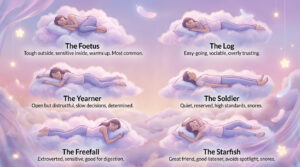
The Foetus — curled up on your side with knees drawn toward the chest. People who sleep this way are described as tough on the outside but soft and sensitive on the inside. They can be shy at first meeting but warm up quickly. This is the most commonly reported sleep position.
The Log — lying on one side with both arms straight down alongside the body. Log sleepers tend to be easy-going and sociable, comfortable in a crowd. The downside is they can be overly trusting and prone to taking people at face value.
The Yearner — on the side with both arms stretched out in front. Yearners are described as open-natured but can be distrustful and at times pessimistic. They take a long time to make decisions but once they have made up their minds they very rarely change them.
The Soldier — on the back with both arms straight down either side of the body. Soldier sleepers tend to be quiet and reserved, not fond of fuss or being the centre of attention. They set high standards for themselves and those around them. This position is also associated with snoring and a less restful night’s sleep.
The Freefall — on the front with hands around the pillow and head turned to one side. Freefallers can appear extroverted and bold but tend to be thin-skinned underneath, sensitive to criticism and uncomfortable in high-pressure situations. On the positive side this position is said to aid digestion.
The Starfish — on the back with both arms up around the pillow. Starfish sleepers make excellent friends, always ready to listen and offer support. They tend to avoid the spotlight. Like the Soldier position, this one is also associated with snoring.
If you’d like to understand how sleep connects to your dream life in more detail, visit our D.R.E.A.M.S. Method™ tutorial — understanding your sleep cycles is the first step to understanding and remembering your dreams.
Frequently Asked Questions
Why do we need sleep?
Sleep serves multiple essential functions including physical restoration and repair, immune system support, memory consolidation, and emotional regulation. While scientists have not yet arrived at a single unified explanation, what is clear is that sleep is as biologically essential as food and water. Chronic sleep deprivation affects cognition, mood, memory, reaction time, and physical health.
What is the difference between REM and NREM sleep?
NREM sleep makes up about 75 to 80% of total sleep time and is divided into four stages from light to deep. It is primarily physically restorative. REM sleep is when the brain reactivates to near-waking levels and most dreaming occurs. The emotional and visual centres of the brain are highly active during REM while the rational prefrontal cortex is quieter, which is why dreams feel vivid and emotionally intense but often follow unusual logic.
How long is a sleep cycle?
Each sleep cycle lasts approximately 90 minutes. A typical night of seven to nine hours produces four to six complete cycles. Early cycles contain more deep NREM sleep. Later cycles contain progressively more REM sleep. This is why the most vivid and memorable dreams tend to occur in the final hours before waking.
How can I get better dreams?
The most impactful things you can do are protect your final two hours of sleep where REM periods are longest, avoid alcohol in the hours before bed as it suppresses REM sleep, keep a consistent sleep schedule, and keep a dream journal by the bed so you can write down dreams immediately on waking before the memory fades. Jean Campbell’s research found that 90% of dream content is forgotten within 10 minutes of waking.
What causes sleep walking?
Sleep walking occurs during deep NREM sleep when the body becomes partially aroused into movement while the brain remains largely asleep. The exact cause is not fully understood but it tends to run in families and can be triggered by stress, alcohol, certain medications, and sleep deprivation. About 10% of adults experience it to some degree and it is more common in children.
What is the difference between nightmares and night terrors?
Nightmares occur during REM sleep, follow a dream narrative, and the person wakes with clear recall of the frightening content. Night terrors occur during deep NREM sleep in the first hours of the night, involve no dream story, and the person wakes in extreme terror with no narrative memory of what caused it. They are fundamentally different phenomena arising from different sleep stages.
Explore the 12 Common Dream Themes
Falling Dreams

Animal Dreams

Being Lost or Trapped

Naked dreams

Flying Dreams

Romantic/Sexual Dreams

Death Dreams

Teeth Falling Out
Water Dreams

House Dreams

Vehicle Dreams

Being Chased or Attacked

Start Interpreting Your Dreams Today
Ready to decode your dreams using personal interpretation rather than generic meanings? Here is how to begin:
Explore a Specific Dream Theme
Click on any of the 12 dream themes above to get detailed interpretation guidance using the D.R.E.A.M.S. Method™. Each page provides:
- Common variations of that dream type
- Research-backed interpretation approaches
- Step-by-step analysis using the D.R.E.A.M.S. Method™
- Real examples showing personal interpretation in action
Learn the D.R.E.A.M.S.
Method™
My foundational method for analyzing any dream.
The Psychology of
Dreaming: A Beginner’s
Guide
Understand the science behind why we dream.
Why Personal Interpretation Works Better: The Research
Multiple lines of research support the personal interpretation approach over generic dream dictionaries:
Cross-Cultural Evidence: Dr. Patricia Garfield’s 36-country study shows that while themes are universal, meanings are deeply personal and cultural.
Neuroscience Validation: Dr. David Kahn’s Harvard research shows that with logical reasoning offline during dreams, your emotional and associative responses provide the most reliable interpretation pathway.
Clinical Evidence: Dr. Gayle Delaney’s 30+ years of clinical practice demonstrates that the “aha!” moment comes from personal recognition, not external interpretation.
Memory Research: Dreams are composed of your memory fragments and personal associations, making personal interpretation more accurate than generic meanings.
Your unconscious mind speaks YOUR language, not a universal one. Learning to decode that personal language is the key to understanding what your dreams are really telling you.