
Learn Dream Analysis: Your Complete Guide to Understanding Dreams
What is Dream Analysis?
Dream analysis is a learnable skill that helps you understand your dreams through systematic interpretation. This guide covers 7 essential topics: the D.R.E.A.M.S. Method™ (a 6-step framework for dream interpretation), dream journaling techniques, how to remember dreams, understanding nightmares, premonition dreams, lucid dreaming, and sleep science. All content is research-backed by 14+ leading experts including Harvard neuroscientists Dr. David Kahn and Dr. Deirdre Barrett, dream researchers Dr. Gayle Delaney and Robert J. Hoss, and clinical psychologists Dr. Alan Siegel and Dr. Stanley Krippner. You don’t need a special gift—just the willingness to learn.
Table of Contents
- Welcome: You Can Learn This
- Featured: The D.R.E.A.M.S. Method™
- 7 Essential Skills for Understanding Dreams • Dream Journals
- How to Remember Dreams
- Dream Interpretation
- Understanding Nightmares
- Premonition Dreams
- Lucid Dreaming
- Understanding Sleep
- Why Learn Dream Analysis?
- Start Your Journey Today
- Expert Voices

Welcome: You Can Learn This
Let me guess – you’ve had an interesting dream (maybe amazing, maybe terrifying, maybe just plain weird), and the first thing you did was google it. You found a dream dictionary that gave you a one-sentence answer like “snakes mean transformation” or “falling means loss of control.”
And now you’re thinking… “That’s it? That doesn’t actually help me understand MY dream at all.”
I get it. I used to do the same thing.
Here’s the truth that took me years to fully understand: dream analysis is a skill, not a gift. You don’t need psychic abilities or special intuition. You just need to learn how dreams actually work and how to ask the right questions.
That’s what this Learn Hub is all about – giving you the practical tools and research-backed methods to become confident in interpreting your own dreams. Because here’s what those dream dictionaries won’t tell you: the author of that dictionary wasn’t the author of your dream. You were. And only you can truly decode what your unique dream symbols mean.
Ready to learn? Let’s start with the cornerstone of everything we teach.
Featured: The D.R.E.A.M.S. Method™
Your Step-by-Step Framework for Dream Interpretation
The D.R.E.A.M.S. Method™ is a systematic, 6-step framework for interpreting any dream. I developed this method over 30 years of study, drawing from the research of leading dream scientists and my own experience teaching thousands of people how to understand their dreams.
The method is built on Dr. Gayle Delaney’s foundational principle that “the dreamer is the expert” on their own dreams. Her 30+ years of clinical research demonstrates that personal associations with dream symbols provide far deeper insights than generic dream dictionary meanings. When you explore what a symbol means to YOU specifically, based on your experiences and current life circumstances, the dream’s message becomes clear.
The framework includes:
- The “6 Magic Questions” technique developed by Robert J. Hoss for unlocking personal symbol meanings
- Color psychology integration based on Hoss’s pioneering research showing that vivid colors signal emotionally significant content
- Life context recording informed by Dr. Alan Siegel’s research on how dreams reflect current life situations and transitions
- Emotional mapping grounded in neuroscience research by Dr. David Kahn (Harvard) and Dr. Stanley Krippner showing that emotions are the KEY to dream meaning
- Problem-solving framework based on Dr. Deirdre Barrett’s (Harvard) research demonstrating 25% success rate for dreams solving waking life problems
What you’ll learn: The complete 6-step process (Document, Record, Extract, Analyze, Map, Solve) with detailed real-world examples showing how to transform a confusing dream into powerful personal insight.
This is where your dream analysis journey begins.

7 Essential Skills for Understanding Dreams
Each of these topics builds your dream analysis capabilities. Start with the D.R.E.A.M.S. Method™, then explore the areas that interest you most.

1. Dream Journals
Your Foundation for All Dream Work
You can’t analyze what you can’t remember, and you can’t track patterns without records. A dream journal is your single most important tool – but it’s more than just writing down dreams.
Why it matters:
Dr. Alan Siegel’s research on dreams across the lifespan reveals that when people keep dream journals that include life context (what’s happening in their waking life), they discover their own recurring symbol patterns. These personal symbols consistently appear during important life transitions, becoming an inner guidance system for navigating future challenges.
The color and emotion connection: Dr. Stanley Krippner’s research emphasizes recording both colors and emotions in your dream journal. His studies show that color is closely related to emotional content – they work together to convey the dream’s message. Robert J. Hoss’s pioneering color psychology research adds that vivid colors indicate emotionally significant content that deserves special attention.
What you’ll learn:
➜ How to set up your journal for maximum insight (not just dream recording)
➜ What to record beyond the dream itself (life context, colors, emotions, timing)
➜ How to track personal symbol patterns over time ➜ Different journaling formats for different styles
➜ How your journal becomes a map of your psychological evolution
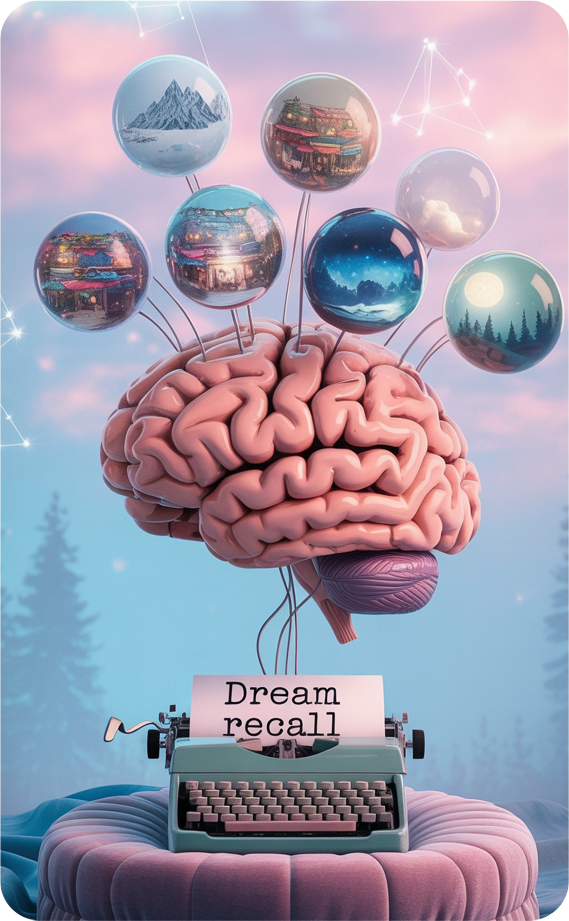
2. How to Remember Your Dreams
The Science of Dream Recall
Here’s a startling fact from memory research: within five minutes of waking, you’ve forgotten 50% of your dream content. Wait ten minutes, and 90% is gone forever.
But here’s the good news – dream recall is a skill you can dramatically improve.
The attention principle: Jean Campbell, President of the International Association for the Study of Dreams, discovered something remarkable in her decades of teaching. Students who initially claimed they “never dream” would suddenly start experiencing multiple vivid dreams once they developed genuine interest. Her key insight: “Dreams are paying as much attention to you as you pay to them.”
Sleep cycle timing: Dr. David Kahn’s neuroscience research at Harvard shows that sleep unfolds in 90-minute cycles, with REM periods (when most vivid dreams occur) getting longer as the night progresses. The dreams you have in the early morning hours are often the most complex and insightful. Understanding this timing helps you optimize dream recall by setting natural wake-up times rather than jarring alarms.
What you’ll learn:
- Why your brain forgets dreams so quickly (the neuroscience explained)
- The critical 5-minute window for dream capture
- Campbell’s proven attention techniques that increase recall
- How to use sleep cycle timing to catch your best dreams
- Practical bedside strategies that actually work
- Why interest and intention matter more than you think

3. Dream Interpretation: The D.R.E.A.M.S. Method™
Your Complete Tutorial
This is your comprehensive guide to the D.R.E.A.M.S. Method™ – the step-by-step framework for interpreting any dream. If you’re serious about learning dream analysis, this is where you start.
Built on decades of research: The method brings together techniques from multiple leading dream researchers. Dr. Gayle Delaney’s clinical work demonstrating that “the dreamer is the expert.” Robert J. Hoss’s “6 Magic Questions” technique and color psychology research. Dr. Alan Siegel’s findings on life context and transitions. Dr. Stanley Krippner’s emphasis on emotions as the KEY to dream meaning. Dr. Deirdre Barrett’s problem-solving framework with documented success rates.
What you’ll learn:
- All 6 steps explained in detail with practical guidance
- How to analyze dream symbols using the 6 Magic Questions
- How to work with color psychology in dreams
- How to map emotional themes and identify patterns
- How to solve waking life connections
- Complete real-world examples showing the method in action
- Troubleshooting for common challenges
This is the core skill. Everything else builds on this foundation.

4. Understanding Nightmares
Finding the Message in Fear
Nightmares can be distressing, but they’re also one of the most powerful calls to attention from your unconscious mind. Rather than something to fear or ignore, nightmares are urgent messages that deserve your attention.
Trauma and healing: Dr. Deirdre Barrett’s research at Harvard Medical School focuses specifically on trauma and nightmares, including PTSD and recurring nightmares. Her work shows that nightmares often process traumatic experiences, and that working with nightmare content using proper techniques can lead to resolution and healing. This isn’t about “getting over it” – it’s about understanding what your mind is trying to process.
Children’s nightmares: Dr. Alan Siegel’s research on dreams across the lifespan includes important insights about nightmares in children and how they relate to developmental challenges. Understanding age-appropriate context helps parents and children work with frightening dreams constructively rather than dismissively.
Medical applications: Wendy Pannier and Rita Dwyer’s work with cancer patients shows that dream work – including working with frightening dreams about illness – leads to measurably decreased stress and anxiety, increased feelings of control, and improved quality of life. Their research documents 80-100% improvement rates in these areas.
What you’ll learn:
- Why we have nightmares (the psychological and neurological function)
- How trauma affects dream content (Barrett’s research) • Lucid dreaming techniques for nightmare resolution
- How to analyze nightmare content safely
- Techniques for reducing nightmare frequency
- How to transform recurring nightmares into healing insights
- Age-appropriate approaches for children’s nightmares

5. Premonition Dreams
When Dreams Seem to Predict the Future
Have you ever had a dream that seemed to come true? These experiences – often called premonition dreams or precognitive dreams – are among the most intriguing phenomena in dream research.
Identifying precognitive dreams: Dr. Marcia Emery’s research on precognitive dreams reveals a key criterion for distinguishing them from ordinary dreams: precognitive dreams are “very lucid” or exceptionally clear – more vivid and memorable than typical dreams. This unusual clarity is the signal that distinguishes potential premonitions from dreams that are simply projecting psychological solutions or processing anxieties.
Spiritual dimensions: Dr. Bob Van de Castle and Rita Dwyer’s work explores dreams with spiritual content that seem to transcend personal psychological boundaries. Their research includes what Van de Castle calls “cosmic dreams” and “postcards from angels” – dreams with messages so clear and profound they don’t require extensive interpretation.
The psychological explanation: Jeremy Taylor and Bob Haden’s work emphasizes that dreams are naturally “forward-looking” – they project possible solutions and future scenarios as part of their problem-solving function. Understanding this helps distinguish psychological projection from genuine precognition.
What you’ll learn:
- Emery’s “very lucid” identification criterion
- How to distinguish precognition from psychological projection
- The psychology of pattern recognition and memory
- Why some dreams feel prophetic
- Spiritual vs. psychological dream messages
- How to evaluate whether a dream was truly predictive
- How to work with these experiences in a grounded, practical way

6. Lucid Dreaming
Conscious Exploration of Your Dream World
Have you ever realized you were dreaming while you were still in the dream? That’s a lucid dream, and it opens up fascinating possibilities for dream exploration, problem-solving, and even healing.
Expert guidance: Robert Waggoner and Ed Kellogg are leading researchers in lucid dreaming, and their work provides detailed, tested techniques for inducing and maintaining lucid dreams. Their research spans decades and includes practical applications ranging from creative problem-solving to documented cases of potential physical healing.
Physical healing possibilities: Waggoner and Kellogg document remarkable cases of physical healing during lucid dream states, including resolution of warts and bronchitis symptoms. While more research is needed to understand the mechanisms, these cases suggest intriguing mind-body connections during conscious dreaming that deserve serious attention.
Nightmare resolution: Dr. Deirdre Barrett’s research shows that lucid dreaming is particularly effective for resolving recurring nightmares. When you become conscious during a frightening dream, you can transform the experience in real-time and often resolve the underlying psychological issue that was generating the nightmare.
Creative problem-solving: Barrett’s studies also demonstrate that lucid dreams can be used for creative problem-solving and exploration. The combination of conscious awareness with the dream state’s associative, non-linear thinking creates unique opportunities for insight and innovation.
What you’ll learn:
- What lucid dreaming is and what happens in your brain during lucid dreams
- Waggoner and Kellogg’s proven techniques to induce lucid dreams
- How to maintain lucidity once you achieve it (it’s trickier than it sounds)
- Using lucid dreams for nightmare resolution
- Creative uses for lucid dreaming (problem-solving, exploration, skill practice)
- Physical healing possibilities in lucid states
- Safety considerations and best practices
- Resources from the Lucid Dream Exchange

7. Understanding Sleep
The Foundation of Healthy Dreaming
You can’t have good dreams without good sleep. Understanding sleep science is essential for anyone serious about dream analysis, as it provides the biological foundation for everything that happens in your dreaming mind.
The neuroscience of sleep and dreams: Dr. David Kahn’s research at Harvard Medical School reveals what happens in your brain during different sleep stages. During REM sleep (when most vivid dreams occur), your brain’s visual and emotional centers are highly active while logical reasoning areas are quieter – explaining why dreams feel vivid and emotionally intense yet often illogical or impossible.
Sleep cycles and dream quality: Kahn’s work shows that sleep unfolds in approximately 90-minute cycles, with REM periods getting progressively longer as the night continues. The dreams you have in the early morning hours (the final sleep cycles) are often the most complex, story-like, and insightful.
What you’ll learn:
- The stages of sleep and what happens in each
- Why REM sleep is crucial for dreaming
- How sleep cycles affect dream quality and recall
- The relationship between sleep quality and dream vividness
- How to optimize your sleep for better dreams
- Common sleep issues that affect dreaming
Why Learn Dream Analysis?
Dreams are one of the most fascinating and underutilized resources for self-understanding. When you learn to interpret your dreams, you gain access to insights about yourself that are difficult to access any other way.
Personal growth: Dreams reveal patterns in your thinking, emotional responses, and behavior that you might not consciously recognize. They show you what’s really bothering you, what you’re avoiding, and what you truly want.
Problem-solving: Dr. Deirdre Barrett’s research demonstrates that dreams can solve real-world problems with a documented 25% success rate when you intentionally “incubate” a problem before sleep.
Emotional processing: Dreams help you process difficult emotions and experiences. Understanding this process helps you work with your dreams constructively rather than being confused or disturbed by them.
Creative inspiration: Many artists, writers, inventors, and scientists have credited dreams with breakthrough insights and creative solutions.
Self-knowledge: Over time, your dream journal becomes a map of your psychological evolution – showing you how you’ve grown, what patterns you’ve overcome, and what themes continue to emerge in your life.
Start Your Journey Today
You now have a roadmap for learning dream analysis. Here’s how to begin:
1 Start with the D.R.E.A.M.S. Method™ – This is your foundation for everything else
2 Begin a dream journal – You can’t analyze what you don’t remember
3 Learn about Nightmares and Premonition Dreama or how to become Lucid in a dream
4 Practice consistently – Dream analysis is a skill that improves with use
5 Be patient with yourself – Understanding dreams takes time and practice
Expert Voices
All content on this site is grounded in research from leading dream scientists and practitioners:
- Dr. Gayle Delaney- Founding President, International Association for the Study of Dreams
- Robert J. Hoss- Past President, International Association for the Study of Dreams
- Dr. David Kahn- Neuroscientist, Harvard Medical School
- Dr. Deirdre Barrett- Assistant Professor of Psychology, Harvard Medical School
- Dr. Stanley Krippner- Professor of Psychology, Former Director of Maimonides Dream Laboratory
- Dr. Alan Siegel- Clinical Psychologist, University of California, Berkeley
- Robert Waggoner- Past President, International Association for the Study of Dreams
- Ed Kellogg- Lucid dreaming researcher
- Jean Campbell- Former President, International Association for the Study of Dreams
- Dr. Marcia Emery- Precognitive dreams researcher
- Dr. Bob Van de Castle- Dream researcher and author
- Jeremy Taylor- Dream work pioneer
- Wendy Pannier & Rita Dwyer – Medical dream work researchers
And many others whose work informs our approach to dream interpretation.
Learn the D.R.E.A.M.S.
Method™
My foundational method for analyzing any dream.
The Psychology of
Dreaming: A Beginner’s
Guide
Understand the science behind why we dream.
Common Dreams
Build Your Personal
Symbol Dictionary
Universal symbols are a starting point. Learn how to map these onto your unique life experiences.